
Fitness Studio or Gym Books CleanupTwo answers on one January draft
The annual contracts hit the bank as one January draft, and the file has to give two answers: which part is taxable dues and which is a live class. We split the draft so the return can tie to the deposit, set trainer pay up with the provider you already run, and close the month before the next draft. On a studio draft the name beside that split is Steven Palmieri, Tax CFO, the Entrepreneur's CFO.


Which charge got mixed.
A Tax CFO reads the year that draft is paying for.
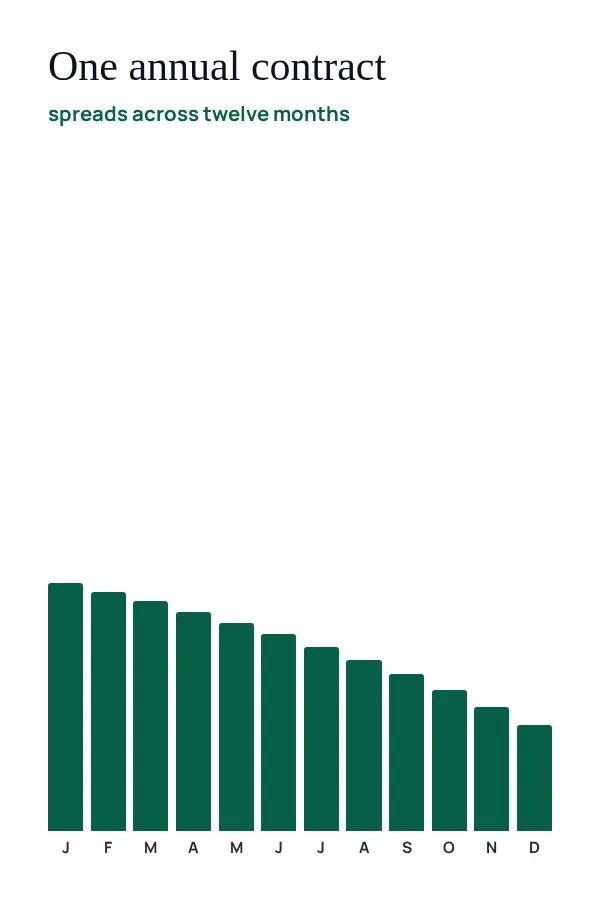
A bookkeeper splits January after it lands. The Tax CFO decides the year the draft is paying for: how many months the annual contract earns across, what trainer pay should look like before the first class, and whether the supplement shelf is worth its tax paperwork. The split is the floor. The year is the work.
The door opens early.
The door opens early: a studio that unlocks before breakfast still splits the draft the same way.
Click to see the door ›Tap to see the door ›
A class has a clock.
A class has a clock: when a person guides the hour it is a class. When the door just opens it is dues.
Click to see the clock ›Tap to see the clock ›December still has a say.
December still has a say: the year can still be read before the January draft sits in the books.
Click to see January ›Tap to see January ›
Steven Palmieri, Tax CFO.
Steven and his team mark the dues before the return.
Click to meet the practice ›Tap to meet the practice ›Bring one draft.
The call opens on the month the annual contracts hit.
Click to pick a time ›Tap to pick a time ›Which bottle is exempt.
A supplement, a shake, and a shirt are three items on the shelf. The membership is a fourth.
Click to read the bottle ›Tap to read the bottle ›Six charges on a draft
Six charges sit on one January draft.
1Open gym dues Taxable amusement
A membership that lets someone walk in is its own line on the draft. If the door is open between classes, the whole membership follows that door.
This charge sits in the taxable sales number.
2An initiation fee Taxable amusement
The fee to join sits with the dues. January is when new memberships and that fee tend to land on the same draft.
This charge sits in the taxable sales number.
3A live class at a set time Outside that tax
Cycling, Pilates, yoga, Zumba, and Jazzercise are the examples. A person guides the hour, and the same live hour taught on a video call stays out of the taxable number.
This charge stays out of the taxable sales number.
4A recorded session Taxable amusement
A library of classes is not a set time. Selling the recording makes that charge taxable even when the live hour was not.
This charge sits in the taxable sales number.
5One person, directed Outside that tax
Personal training stays out of amusement tax only when the charge is stated apart from the membership and the trainer directs that one person through the workout.
This charge stays out of the taxable sales number.
6A program with no session Taxable amusement
Designing a program and explaining the machines, without directing the hour, does not meet the test. That fee does not borrow the exemption.
This charge sits in the taxable sales number.
What the deposit has to show.
The cleanup starts with the bank deposit. Taxable dues and a live class stay on separate lines so the return can tie to that deposit.
An accountant can file the month that already closed. The next open January still has time to pull one charge onto its own line. Open gym dues, a live class, a recording, and one to one training are the four decisions we keep apart.
A live class has a set time and a person guiding the hour. That hour is its own line on the draft. The cash method looks at what arrived, not at the visits still ahead.
When the open door taxes the membership.
The draft has to say whether members can walk in between classes. A membership that includes an open door is a different charge from a class that is the only time the door opens. Those two charges need two lines, because a state that taxes them differently cannot see the difference inside one amount. If the membership includes the open door, the membership follows that door even when a class inside it would have been its own line.
Initiation fees and membership fees land in January for a lot of studios, because getting healthy is a common resolution. Parking lots fill after the first of the year. That is the month the dues and the tax, where a state has one, stack together. The draft should name the fee to join on its own line beside the monthly dues, so the return can see both.
What one to one training shows.
Where a state treats one to one training differently from an open door, three facts have to show on the invoice together. The charge is stated separately from the membership. The training is one person at a time. The trainer directs that person through the workout. A fee for designing a program and explaining the machines, without directing the session, does not meet that test. Pages that treat all training as one item skip the directing test.
The invoice has to say the training apart from the dues. A line that only says coaching, with no person and no hour, is not enough. Send one training charge and say whether it was one person and whether the trainer was in the hour.
Why a recording is a different line.
A live class at a set time, including one taught on a video call while the instructor is guiding it, is a different item from a recorded session the member plays later. A library of classes is not a set time class. The same movement, sold as a file, follows the recording line on the draft.
Owners sometimes drop the library into the class item because the billing screen has one button for content. The sales tax return cannot see that button. It can see two items, or it can see one item that overstates the taxable sales.
When a January draft is income.
Under the cash method in Publication 538, gross income includes all items actually or constructively received during the year. An advance payment for services is generally income in the year it is received. Deferring part of an advance to the next year is allowed only when the publication's tests are met, including that a portion is earned next year or sits in an applicable financial statement next year.
A January membership draft is income when the gym receives it unless those tests are met. Writing an annual fee into twelve liabilities describes a different method. The sales tax return follows the tax rules, not the wish to spread the cash. Send the January draft and say whether any of it is for a later year. The longer read is on the month the money arrives.
Which bottle meets the exemption.
A supplement, a shake, and a shirt are three shelf items, and the membership is not any of them. A gym that sells shakes, apparel, or other goods still has to name those goods apart from the dues. Pages that tax every bottle, and pages that treat every bottle as one item, both overshoot the folder.
The shelf list is the record. Mark the supplement and the shake as two items. Prices can stay covered when you send the list. The question is which item meets the definition, not what the front counter decided in a hurry on the second of January.
Which credential is in the massage room.
A gym that adds massage has to know which credential is in the room before the fee is grouped with the dues. Say who performed the massage. The fee can stay covered. The credential and the sales category are two questions, and the invoice has to leave room for both.
A state may require a sales tax permit when taxable services are sold, and that permit is a different paper from a professional credential. Massage credentialing, where a state has it, sits apart from sales tax and apart from a cosmetology credential. Say who performed the hour. This practice does not decide a credential. Open the disclosures page if you want the list of signatures this practice turns down.
Which 2026 form.
For payments made in 2026, a gym files Form 1099-NEC for 2,000 dollars or more paid for services by someone who is not an employee, such as a trainer who is truly an independent contractor. The threshold before 2026 was 600 dollars. Whether a trainer is an employee is the IRS common law test, not the job title. A contract that says contractor does not decide the question if the gym controls how, when, and where the work is done.
This practice does not run payday. Setup, if it is needed, is on a provider the studio already runs. The question on the form is which person was paid as an employee and which person met the contractor test. Names can stay covered. The pattern cannot. A trainer who also rents the room is a second paper, and that hour is read on the trainer page.
Which equipment year the return uses.
Name the studio's election before the draft is tied to a federal return. Partnerships report on Form 1065 and S corporations report on Form 1120-S. For a year that follows the calendar, the Service wants both of those in the third month, on day fifteen. C corporations report on Form 1120. A single member company with no election reports through the owner's Form 1040, and the Service wants those in the fourth month, on day fifteen. When day fifteen is a Saturday, a Sunday, or a legal holiday, count the next morning the Service unlocks its doors.
For a tax year beginning in 2025, section 179 is limited to 2,500,000 dollars and phases out above 4,000,000 dollars. The SUV cap for that year is 31,300 dollars. Qualified property acquired and placed in service after January 19, 2025 can take 100 percent additional first year depreciation. Cardio equipment and strength equipment are the assets this usually hits. A passenger automobile has separate caps, and those caps are not borrowed from another trade.
What a closed month ties to.
Initiation fees and open gym dues belong on their own lines of the draft. Separately stated one to one training and live classes stay on theirs. Mixing them is how a studio cannot tie the month the annual contracts are charged. Where a state taxes the membership, that tax has to be visible on the agreement or meet that state's notice for tax included in the price.
Membership agreements that bury tax in the monthly draft still have to back the tax out, with the price divided by one plus the rate the state published. A card fee the gym adds onto a membership is part of the price the member paid. The fee the processor keeps from the deposit is the gym's expense. Reporting the net deposit as sales understates both income and the sales the return is built on.
Where the gross receipts test starts.
The gross receipts test in section 448 is met when average annual gross receipts for the three prior tax years are 25,000,000 dollars or less, adjusted for inflation. For a taxable year beginning in 2025, the Internal Revenue Bulletin states that inflation adjusted amount is 31,000,000 dollars. A gym under that line, and that is not a tax shelter, is a small business taxpayer for the accounting method rules.
The page states the line. It does not tell a reader they have met it. Billing software that drafts cards on the first of the month is the sales journal. Dues and training have to be separate items in that draft. The federal information return and the income tax return still need that split, even when a state return is filed on a different system.
Bring January's draft.
Send the month the annual contracts hit. We will say if those lines can split.